|
TL;DR - QUICK TAKEAWAYS:
|
For years, PR teams were told to “think like publishers.” Get your keywords right. Rank on page one. Win the click.
But that playbook is starting to unravel.
As teams look ahead to what 2026 has in store, one shift is hard to ignore: AI systems will be the ones deciding which brands get seen and which don’t. In fact, estimates suggest that 20-50% of traditional search traffic is already at risk.
For newsroom content, that’s a big shift. You’re no longer optimizing only for rankings, but for the chance of being selected, understood, and reused by AI.
Enter two interchangeable terms: Generative Engine Optimization (GEO) and Answer Engine Optimization (AEO).
Don’t get it twisted – SEO still matters. But GEO/AEO focuses on whether your content is clear, authoritative, and structured enough for AI systems to confidently reuse it in their answers and attribute it back to you.
In this guide, we’ll break down SEO and GEO in plain English, specifically for newsroom and PR teams. You’ll learn where AI discovery happens, what’s changed (and what hasn’t), and how to adapt your newsroom content without reinventing your entire workflow.
Why SEO and GEO Matter for Today’s Newsrooms
Before you worry about another acronym, here’s the good news: most of what you already do for SEO still applies.
Clear structure. Descriptive headlines. Logical internal links. These “old SEO tricks” are the foundations that help both search engines and AI systems understand your content.
What has changed is where that understanding gets applied.
Earned media still plays an important role in visibility. Research from Muck Rack shows that third-party coverage influences how brands surface across search and AI experiences. But here’s the catch: if your story isn’t clear in owned media, paid, shared, and earned media don’t amplify clarity, they amplify confusion.
For PR teams, this matters because visibility isn’t the only thing at stake. When your newsroom content isn’t clear or structured enough, AI systems still answer questions, just without your input. That’s when nuance gets stripped, context goes missing, and attribution becomes unreliable.
Worst case? AI fills the gaps with assumptions, outdated info, or third-party sources that don’t reflect your position at all.
That’s why getting this right matters. SEO helps your newsroom content get indexed, ranked, and clicked. GEO builds on the same foundations, but determines whether your content is selected, summarized, and cited by AI systems.
For most newsrooms, the fix is simple: tighten what already works.
What Is GEO vs SEO for PR Newsrooms?
Now that we’ve established why both concepts matter, let’s get specific about what SEO and GEO mean in a newsroom context. Because while the concepts overlap, they serve different roles in how your content gets discovered and reused.
What Is SEO in the Newsroom Context?
SEO makes sure your newsroom content shows up when people go looking for it and that search engines actually understand what they’ve found.
In practice, this means structuring PR stories and releases so search engines can immediately grasp what the story is about, why it matters, and how it connects to the rest of your newsroom.
Strong SEO for PR professionals typically comes down to:
- Researching the keywords and questions your audience searches for
- Structuring content around those terms without ‘stuffing’ them
- Using clear, descriptive, keyword-aligned headings
- Linking internally to related announcements, updates, and background stories
- Linking externally to trusted sources when referencing statistics or data
- Creating clean metadata (H1, title tag, URL slug, meta description) that reinforces context
Done well, SEO helps your newsroom content appear at the moment journalists, stakeholders, and audiences go looking for it.
What Is GEO in the Newsroom Context?
GEO (and AEO) is about making sure your newsroom content can be used, not just found.
It focuses on whether AI systems can confidently understand, extract, and reuse your content when generating answers. That includes AI-powered search results, summaries, and answer engines, often without sending traffic back to your site.
Systems need to quickly realize who is speaking, what is being stated as a fact, what the announcement really means, and which source is credible enough to cite.
Practically, GEO-ready newsroom content is built by:
- Making authorship, dates, and sources explicit
- Leading with a clear summary that answers the main question immediately
- Structuring stories using an inverted pyramid structure, with the most important information at the top
- Writing headings and subheadings that reflect real questions audiences ask
- Using plain, non-salesy language and avoiding implied context
- Structuring content so key facts stand on their own
- Reinforcing credibility through consistent publishing and attribution
If you nail your GEO strategy, you increase the chances that your newsroom content is accurately summarized, correctly attributed, and surfaced when AI systems answer questions about your brand.
To summarize: SEO vs. GEO in Online Newsrooms
| Newsroom SEO | Newsroom GEO | |
| Primary goal | Help content get found and ranked in search results | Help content get selected, summarized, and cited by AI systems |
| Optimized for | Search engines and keyword-based queries | AI answers, summaries, and generative search results |
| Discovery moment | When someone actively searches | When AI systems generate answers, often before a click |
| Core focus | Keywords, structure, and relevance | Clarity, authority, and reusability |
| Content structure | Optimized pages with clear headings and links | Use of bullet points, key takeaway summaries, FAQs, and inverted pyramid with key facts upfront |
| Writing style | Informative and search-friendly | Question-answer driven and self-contained |
| Key signals | Headings, internal links, metadata | Summaries, authorship, sourcing, explicit context |
| Success looks like | Rankings, impressions, clicks | Accurate summaries, stable citations, correct brand attribution |
Where GEO happens: The Channels that Matter most
The tricky bit about GEO or AEO is that it doesn’t live in one place. It plays out across a growing set of AI-driven search and answer experiences where your brand newsroom content may be cited.
Understanding where this happens helps PR teams prioritize how they structure and publish content.
AI Overviews and AI Search Results
AI-driven search results are increasingly the first thing users see. It shows up as a synthesized answer pulled from a number of sources.
These include:
- Google AI Overviews, which summarize answers directly in search results
- Bing / Microsoft Copilot–style summaries, where AI combines web results into a single response
In these environments, visibility depends less on ranking first and more on being understandable and trustworthy enough to be included at all.
Answer Engines and AI Assistants
Beyond search engines, GEO also plays out inside dedicated answer tools and conversational AI interfaces.
Examples include:
- Perplexity, which cites sources directly in its responses
- Chat-based AI assistants like ChatGPT that answer questions conversationally using trusted web content
These systems often rely on newsroom-style content because it’s:
- Timely and factual
- Written to explain, not sell
- Published with clear ownership and attribution
For PR teams in 2026, this means your newsroom may be “read” by AI systems before it’s read by humans.
How to Get Started: Practical GEO & SEO Steps for Newsrooms
Enough theory. Let’s get into the practical steps you can take to move your newsroom from SEO-ready to GEO-ready.
Luckily, you don’t need to rebuild everything from scratch. Most improvements come from sharpening the basics you already control.
Here’s where to get started.
1. Own Authorship and Attribution
AI systems care deeply about who is speaking, so make sure to make authorship obvious in every online newsroom story.
Practically, this means:
- Clearly naming the organization and, where relevant, the spokesperson relevant to the release
- Including publish dates and update labels
- Attributing quotes, data, and claims explicitly
This helps AI systems distinguish facts from opinions and gives them confidence to reuse and cite your content.
A practical example of good vs. bad GEO
| ❌ Bad: Unclear ownership and attribution | ✅ Better: Clear authorship and explicit attribution |
| Headline: Company X responds to recent reports | Headline: Company X responds to recent reports |
| Body excerpt: We take these reports seriously and are reviewing the situation. Further updates will be shared as appropriate. | Byline & date: Statement from Company X – 12 February 2026 Body excerpt: “Company X is reviewing the situation and will provide further updates,” said Jane Smith, Head of Communications at Company X. |
Why this works: Same message. Very different outcome. The second version spells out ownership, timing, and attribution, leaving nobody guessing who is speaking.
2. Structure Content in a Question-and-Answer Format
AI systems are built to answer questions. Your content should reflect that.
Practically, this means:
- Writing headings that answer a specific question or state a clear outcome
- Using subheadings that mirror common “who / what / why / how” questions
- Making sure each section can stand on its own without relying on earlier context
This makes your content easier to extract, summarize, and reuse accurately.
A practical example of good vs. bad GEO
| ❌ Bad: Narrative-first release | ✅ Better: Question-answer structure with facts upfront |
| Headline: Company X provides update on recent developments | Headline: What changed at Company X – and what it means for stakeholders |
| Opening paragraph: Company X would like to provide an update following recent changes. The company has been working closely with relevant stakeholders and will continue to share more information as it becomes available. | Opening paragraph: Company X has updated its operational processes following new EU regulations. The changes affect EU logistics timelines and take effect from 1 March 2026. |
Why this works: The headline frames a clear question. The summary answers it immediately. Each section contains standalone facts that can be accurately summarized or cited by AI systems.
3. Add Clear Summaries at the Top of Every Story
Don’t make readers – or machines – search endlessly for the point of your story. Otherwise you might lose them.
Start each newsroom item with a short summary that explains:
- What happened
- Why it matters
- Who it affects
Spelling out the most important takeaways supports both GEO (AI summaries and answers) and SEO (featured snippets and rich results).
A practical example of good vs. bad GEO
| ❌ Bad: No summary, buried lead | ✅ Better: Clear summary upfront |
| Headline: Company X announces changes to its supply chain operations | Headline: Why company X is updating supply chain operations following new EU regulations |
| Opening paragraph: Company X today announced updates to its supply chain operations as part of its ongoing efforts to adapt to changing market conditions. The company continues to work closely with partners across the region. |
Summary: |
Why this works: The story is identical. But by including a short summary at the top of the press release or PR content piece, it’s easier to read, extract, and reuse.
4. Use Plain Language (and State the Obvious)
In the GEO game, nothing sucks more than being cited – but incorrectly. AI struggles with implied context, so this is the moment to be unapologetically clear.
Practically this means:
- Avoiding internal jargon and shorthand
- Explain acronyms and industry terms
- Not assuming prior knowledge of your company or announcement
If something matters, say it directly. Clear beats clever every time.
A practical example of good vs. bad GEO
| ❌ Bad: Jargon-heavy and implied context | ✅ Better: Plain language with context spelled out |
| Body excerpt: Following the completion of Phase 2, the programme is now embedded across the organisation, enabling enhanced alignment and value creation while supporting our long-term strategic ambitions. | Body excerpt: The company has completed the second phase of its restructuring programme. This phase focused on simplifying internal processes and reducing operating costs across finance and operations teams. |
Why this works: Clear language makes the intent obvious. When the facts are spelt out, there’s far less risk of confusion or misinterpretation.
5. Publish HTML-first, not PDFs
AI systems are far better at interpreting HTML than downloadable files, and they strongly prefer content they can easily read and reference.
Practically, this means:
- Publishing stories directly in your newsroom, not as gated downloads
- Using PDFs as supporting assets, not primary content
- Making sure key facts live in crawlable, structured HTML text
Do this well, and you significantly improve both discoverability and reuse across search engines and AI-driven answers.
6. Strengthen Internal Linking across your Newsroom
A newsroom without internal links is a series of alone standing pieces of PR content. A newsroom with them is a knowledge base.
Show how everything connects to part of a bigger story by linking between:
- Announcements and relevant background stories
- Updates and earlier releases on the same topic
- Product news and related leadership or strategy commentary
Strong internal linking helps AI systems understand relationships between topics and reinforces your authority on the themes you want to own.
A practical example of good vs. bad GEO
| ❌ Bad: Isolated PR content | ✅ Better: Connected newsroom content |
| Body excerpt: Company X today announced an update to its sustainability strategy. The company remains committed to reducing emissions and supporting long-term environmental goals. | Body excerpt: Company X today announced an update to its sustainability strategy, building on its 2024 emissions reduction plan and previous commitments outlined in its climate roadmap. The update aligns with the company’s long-term sustainability targets set by its executive team. Further reading: - Company X’s 2024 emissions reduction plan - Climate roadmap: targets and milestones - Statement from the Executive Team on sustainability priorities |
Why this works: Internal and inline “further reading” links turn a single announcement into a connected story. They give immediate context, guide readers deeper, and help AI systems understand how individual updates relate to your broader narrative.
7. Prioritize relevance and authoritative sources
GEO doesn’t just look at structure. When someone types a prompt into an AI engine, it evaluates relevance and authority at scale, scanning large volumes of content to identify the most credible, prompt-relevant information.
That means AI systems actively look for well-sourced, fact-based content, not just clean formatting.
Practically, this means:
- Supporting key claims with sources, data, or named spokespeople
- Linking to high-authority external sources when referencing research or industry trends
- Making sure your own newsroom is the primary source for your official statements
Unlike traditional SEO, this is harder to “optimize around.” AI systems prioritize substance over tactics. If your content isn’t relevant to the question or backed by credible sources, it simply won’t be selected.
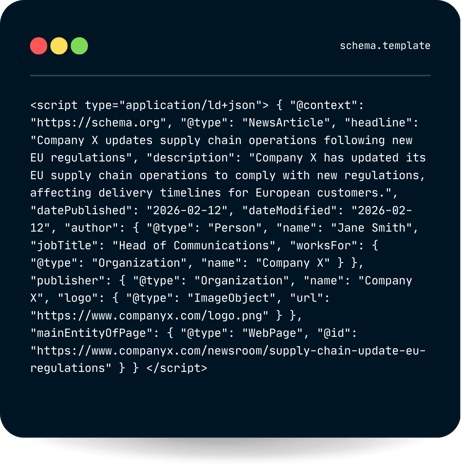
8. Mark Up Content with Basic Schema
Schema is how you remove guesswork for machines.
It’s a cheat sheet that helps search engines and AI systems understand what your content is, who it’s from, and how it should be interpreted.
Practically, this means making sure your newsroom supports:
- Article or NewsArticle markup
- Clear author and organization information
- Publish dates and headlines
You don’t need to over-engineer this. Basic, consistent schema goes a long way, especially when applied across your entire newsroom.
Example of a Basic NewsArticle Schema
How Presspage Helps Newsrooms Get SEO-
and GEO-Ready
All of the steps above are easier when your newsroom is built for structure, ownership, and clarity by default.
Presspage helps PR teams publish owned newsroom content in a way search engines and AI systems can understand. From HTML-first publishing and consistent structure to clear authorship and internal linking, Presspage helps newsrooms support both SEO and GEO without adding manual work.
Instead of retrofitting PR content for AI visibility, PR teams can focus on what they do best: publishing timely, authoritative stories, while knowing that the foundations for modern search and AI discovery are already in place.
FAQ about PR SEO & GEO in 2026
What is the difference between SEO and GEO for PR newsrooms?
SEO focuses on helping corporate newsroom content get indexed, ranked, and discovered through traditional search queries. GEO focuses on whether that same content is selected, summarized, and cited by AI systems when generating answers, often without a click to your site.
What’s the difference between GEO and AEO?
GEO (Generative Engine Optimization) and AEO (Answer Engine Optimization) refer to the same practice: structuring content so AI systems can accurately extract, summarize, and cite it. Both focus on clarity, attribution, and machine-readable structure rather than rankings alone. The terms are often used interchangeably.
Do PR teams still need SEO if GEO is becoming more important?
Yes. GEO builds on SEO, it doesn’t replace it. Clear structure, strong headlines, internal linking, and metadata are still essential foundations, in 2026, they just support both search engines and AI-driven discovery.
How do AI systems decide which newsroom content to cite?
AI systems tend to favor content that is clearly structured, fact-based, and attributable. Newsroom content with explicit authorship, clear summaries, reliable sourcing, and plain language is more likely to be reused accurately in AI answers.
Can PR content appear in AI Overviews and answer engines?
Yes. Well-structured PR content published in HTML – with clear headlines, summaries, dates, and sources – is often used by AI systems, especially when they explain developments clearly and avoid sales-heavy language.
What’s the fastest way to make a newsroom more GEO-ready?
Start by tightening the basics: add clear summaries at the top of every story, make authorship and sources explicit, publish HTML-first, strengthen internal linking, and structure content using a question–answer mindset with key facts upfront.
The Takeaway
SEO gets your newsroom on the map. GEO decides whether it actually gets quoted.
In 2026, visibility is about whether your content is clear, credible, and structured enough for AI systems to pick up and pass on. The silver lining? You don’t need to start over. You just need a newsroom that’s built for modern discovery.
If you want to see what that looks like in practice – and what PR teams need to change now – join our upcoming live webinar:
The renaissance of owned media: 2026 PR playbook for AI search
📅 February 26, 2026
🕒 15:00 – 16:00 CET