
|
PR teams are publishing more than ever, and yet, fewer people are clicking through from search. AI-driven search experiences, including Google AI Overviews, now answer questions directly on the results page. That shift changes how visibility works. Brands that rely only on earned coverage or scattered blog posts lose control fast. Brands with strong owned media hubs do not. That is why the online newsroom matters again. Not as a static press page, but as a living publishing environment that feeds journalists, search engines, AI systems, and stakeholders from one place. In this guide, we break down what online newsroom software actually is, how to choose the right platform in 2026, and which tools stand out depending on how your PR team works. |
TL;DR - Key takeaways:
- Online newsrooms now act as owned media hubs, not static press pages
- AI-driven search rewards structured, authoritative sources like newsrooms
- Newsroom-first platforms differ from PR suites where publishing is secondary
- Global teams need governance, localisation, and reuse built into publishing
- The best newsroom software supports visibility long after distribution
What is an online newsroom?
An online newsroom is a brand’s owned media hub for press releases, announcements, media assets, and official statements. It acts as the single source of truth for journalists, analysts, and increasingly, AI systems that summarize brand information.
A modern newsroom looks like a structured publishing environment with SEO control, media-friendly layouts, distribution hooks, and governance built in.
This matters because owned media now plays a bigger role in how brands show up across the web.
Around 60% of larger brands host a dedicated newsroom or press section, where they publish releases, media assets, and statements.
Journalists still rely on these hubs. Over 70% name press releases as their preferred PR content format, which reinforces the need for a newsroom that is easy to navigate, searchable, and current.
An online newsroom is also a core pillar of an owned media strategy. It gives PR teams a place to publish first, control context, and anchor coverage that appears elsewhere.
How to choose the newsroom software that is right for you
Choosing newsroom software in 2026 is less about templates and more about control.
Search behavior has changed. AI systems now summarize brand information by pulling from trusted sources. Newsrooms that are structured, current, and clearly attributed are far more likely to be referenced than a handful of disconnected blog posts or static PDF libraries.
53% of all website traffic in 2025 came from organic search, and brands with active PR and content programs attribute an estimated 10 to 15 percent of that traffic to PR-driven owned content.
At the same time, 60% of PR professionals point to closer integration between PR and SEO as a priority, which puts pressure on newsroom structure, metadata, and publishing workflows.
When evaluating newsroom software, PR teams should look beyond surface features and ask a few hard questions:
- Can this newsroom act as our primary publishing source?
- Does it help our content show up clearly in search and AI summaries?
- Can global teams publish without breaking consistency?
- Does distribution connect back to the newsroom, or live somewhere else?
The answers separate tools built for modern PR from tools that simply host content.
Features to look for in your newsroom software
Newsroom hosting
Your newsroom should live on your domain or a branded subdomain. This reinforces trust with journalists, improves search visibility, and gives your team full control over publishing cadence and archives.
Look for platforms that handle hosting, security, performance, and uptime without pushing you toward external content libraries.
SEO-friendly structure
Search engines and AI systems rely on structure. Headlines, metadata, internal linking, and clean URLs all matter.
A newsroom should let PR teams control:
- Page titles and descriptions
- Structured headlines and summaries
- Canonical URLs
- Media asset indexing
If SEO lives outside the newsroom, visibility suffers.
Localized newsrooms
Global organizations need central oversight and local autonomy. The right platform supports multiple languages, regions, and teams without fragmenting content.
This includes language syncing, shared templates, and clear publishing permissions so local teams move fast without going off-brand.
Integrated distribution
Publishing and distribution work best together. Sending a release by email or wire should link back to the newsroom as the authoritative source.
That loop matters for analytics, search visibility, and long-term content recycling. Tools that separate publishing from distribution often create reporting gaps and duplicate work.
Best Online Newsroom Software in 2026: Top Picks
Below are newsroom platforms* that offer dedicated newsroom software, not just distribution or media databases. Each serves a different type of PR team.

1. Best for fast-moving startups and scale-ups: PR.co
PR.co focuses on clean newsroom presentation and straightforward publishing. It works well for smaller teams that want to publish releases, host media assets, and get started without heavy setup.
The platform emphasizes visual presentation and simplicity, which suits teams with light approval flows and limited localization needs.
Trade-off: Where it falls short is scale. As publishing volume and governance requirements increase, teams may start to feel those limits.

2. Best for media pitching alongside newsroom publishing: Prowly
Prowly combines newsroom functionality with pitching and media database features. This makes it attractive for teams that want publishing and outreach in one interface.
The newsroom component supports press releases, media kits, and brand assets, with solid search visibility options.
Trade-off: Teams that prioritize newsroom governance or complex regional publishing may find the focus leans more toward outreach than owned media structure.

3. Best for storytelling-focused PR teams: Prezly
Prezly puts emphasis on narrative formats, multimedia stories, and relationship-based PR. Its newsroom experience supports long-form storytelling and visual layouts that feel closer to a magazine than a traditional press page.
For brands that publish fewer releases and invest more in editorial-style content, this approach can work well.
Trade-off: Organizations with high publishing volume or strict governance requirements may want more control over structure and workflows.

4. Best for complex, global PR teams: Presspage
Presspage is built for organizations that treat the newsroom as a strategic publishing engine, not a side project.
The platform combines newsroom hosting, structured publishing, distribution, and analytics in one environment. This makes it easier for teams to publish once and reuse content everywhere, from email distribution to social and search.
Presspage supports:
- Central and local newsroom setups
- Multilingual publishing with shared templates
- SEO-ready structures that AI systems can reference
- Integrated email distribution tied directly to newsroom content
Trade-off: Presspage is designed for teams with mature PR operations. Smaller teams with very basic needs may not use its full depth.

5. Best for regional visibility and media reach: Mynewsdesk
Mynewsdesk combines newsroom publishing with a strong regional distribution network, especially in the Nordics. It works well for organizations that want to reach local media across multiple markets.
The platform offers structured newsroom pages and distribution options that help content surface within its ecosystem.
Trade-off: Brands looking for deeper control over owned media architecture may want more flexibility.

6. Best for enterprises already invested in media databases: Cision
Cision offers newsroom software as part of a broader PR suite that includes media databases, monitoring, and analytics.
For large organizations already using Cision for outreach and tracking, the newsroom can act as a central publishing destination that connects to those workflows.
Trade-off: The downside here is focus. The newsroom exists within a sprawling platform, which can make newsroom-specific structure and governance harder to prioritize.

7. Best for communications teams combining IR and PR publishing: Notified
Notified provides newsroom software alongside media monitoring and investor communications tools. This makes it relevant for organizations that publish both PR and regulated communications.
The newsroom component supports releases, statements, and media assets, particularly in corporate and financial contexts.
Trade-off: Teams looking for a newsroom-first experience may find the platform leans more toward monitoring and compliance use cases.

8. Best for teams focused on media monitoring: Meltwater
Meltwater is known for media monitoring and insights, with newsroom functionality included as part of its broader platform.
The newsroom supports publishing and hosting content, which works well for teams that already live inside Meltwater for analysis and reporting.
Trade-off: As with other suite-first tools, the newsroom is one part of a larger system rather than the central foundation, and similar to Notified, the platform is monitoring-heavy.
*All competitor insights in this blog are based on publicly available info. We pulled details from:
|
What makes Presspage’s online newsroom stand out
Presspage stands out because it treats the newsroom as the foundation of modern PR work.
Instead of separating publishing, distribution, and reporting, everything starts with the newsroom. Each release becomes a reusable asset that feeds email campaigns, social channels, media outreach, and search visibility.
This matters as AI systems increasingly reference original sources. A newsroom that is structured, current, and clearly attributed gives brands a stronger chance of being cited in AI summaries and Overviews.
Presspage also supports real-world PR complexity:
- Central teams set structure and standards
- Local teams publish confidently within guardrails
- Leadership sees clear performance signals across regions
That balance is why Presspage works well for airlines, listed companies, universities, healthcare institutions and energy brands with multiple stakeholders and high scrutiny.
The wrap: Best online newsroom software by use case
Here is how the platforms compare at a glance, based on how PR teams actually work:
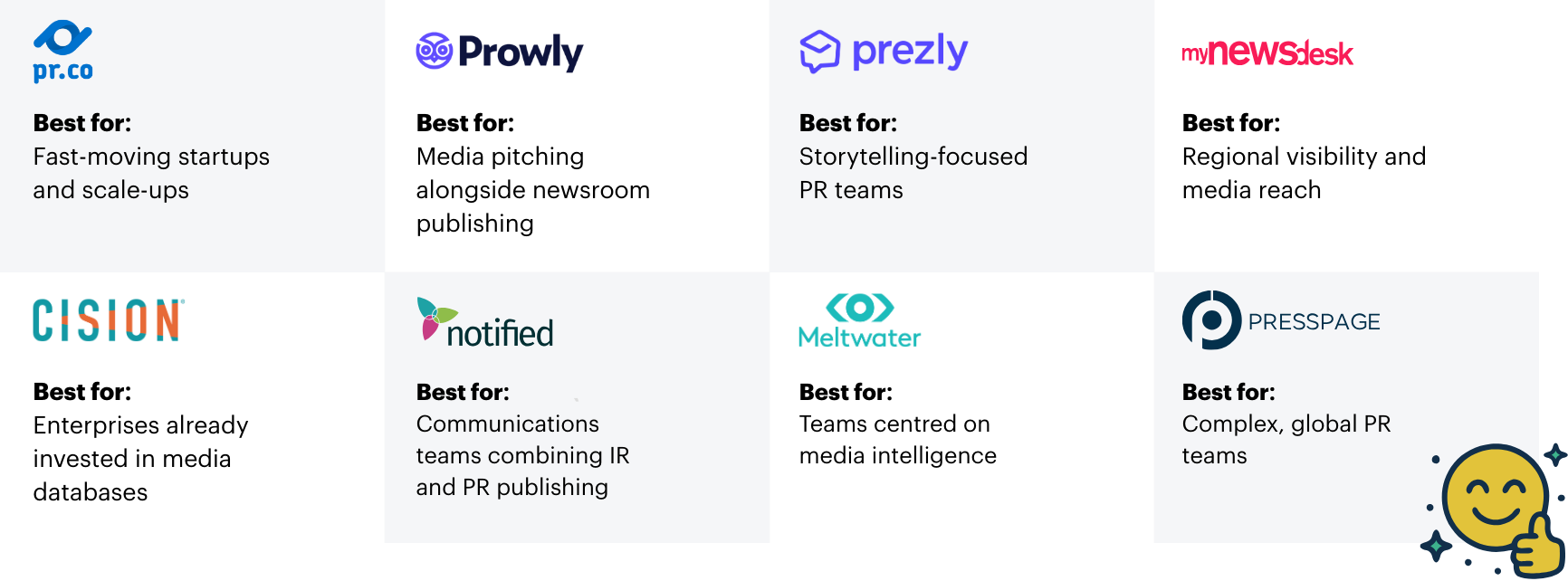
- PR.co: Small teams that want quick setup and clean presentation
- Prowly: Teams focused on pitching and outreach
- Prezly: Editorial-first PR teams
- Mynewsdesk: Organizations prioritizing regional reach (with a Nordic focus)
- Cision: Enterprises anchored in media databases
- Notified: Teams combining PR and regulated communications
- Meltwater: Media intelligence-led teams
- Presspage: Global teams managing high-volume, multi-market publishing
The Takeaway
Online newsrooms are no longer static archives. They are active publishing systems that shape how brands are seen by journalists, stakeholders, search engines, and AI platforms.
Choosing the right newsroom software in 2026 comes down to one question: Can this platform act as our primary source of truth?
For teams managing global operations, multiple languages, and high publishing expectations, the newsroom needs to anchor visibility.
Explore Presspage’s newsroom software
See how Presspage helps PR teams publish, distribute, and manage newsroom content from one place.