|
TL;DR - Key takeaways:
|
Most PR teams understand the importance of crisis communication. What they often lack is a concrete framework to rely on when things get messy.
When a crisis hits, everything speeds up, often without warning. Teams jump into action, with monitoring, drafting, approvals, and internal updates happening at the same time. But without a shared structure, things can get messy. Teams move at different speeds, decisions stall, and the story takes shape before you have a chance to respond.
Even though 72.4% of organisations activated their emergency communications plan in the past year, only 49% have a structured approach behind it.
So yes, plans exist. But execution still breaks down. That’s exactly what a clear crisis communication framework is built to fix.
In this article, we’ll break down our Crisis Lifecycle Framework and show how to apply it IRL.
What is the Crisis Lifecycle Framework?
The Crisis Lifecycle Framework is a structured approach to crisis communication that breaks response into six practical stages:
- Sense
- Frame
- Manage
- Act
- Recover
- Improve
Instead of treating a crisis as a single moment, the framework sees it as a sequence of decisions.
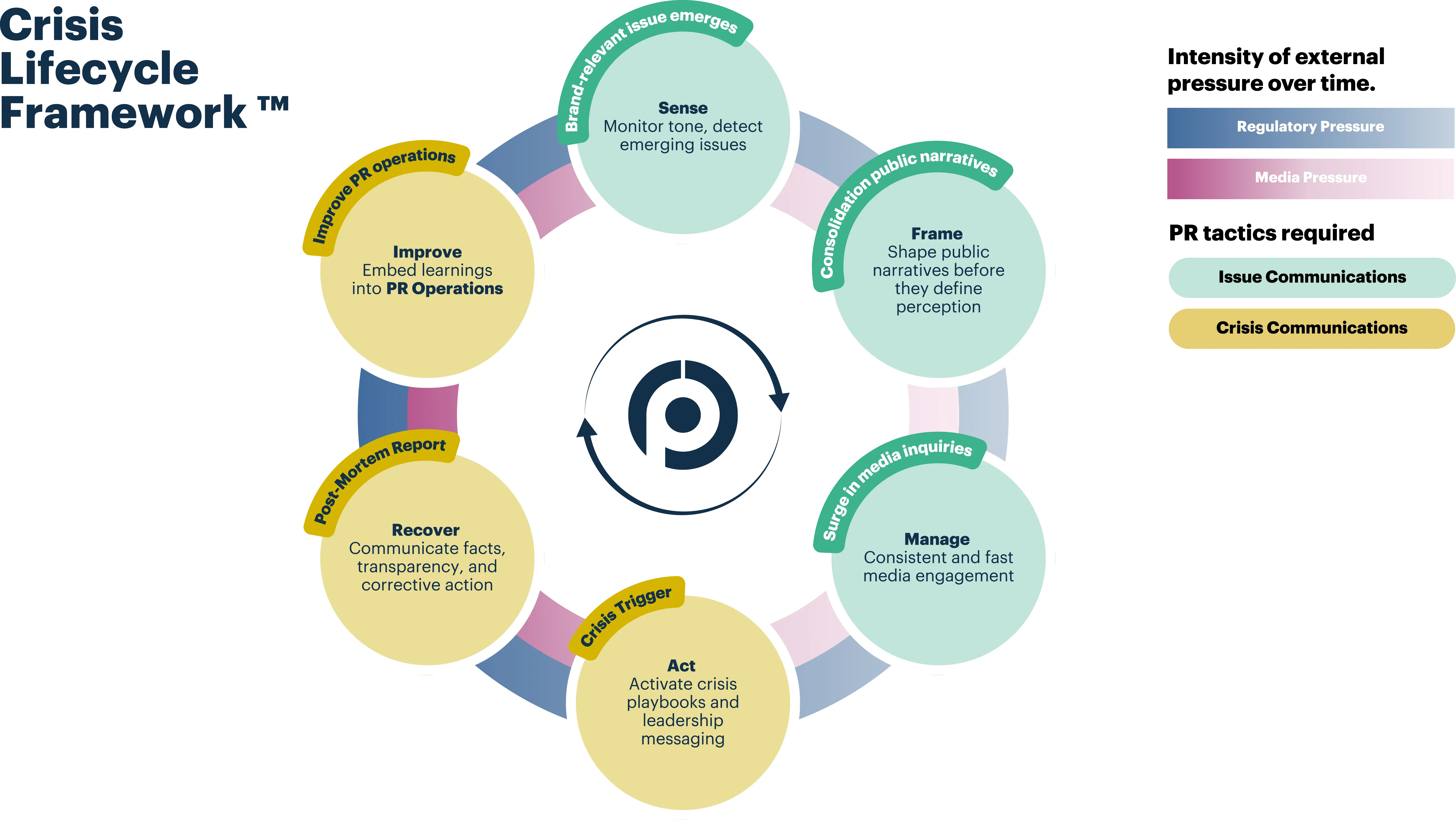
Each stage answers a different question:
- Are we aware of what’s happening?
- Have we defined the narrative?
- Are teams aligned internally?
- Are we responding externally?
- Have we stabilized the situation?
- What did we learn?
This is what makes it useful. It outlines actions AND gives teams a clear way to coordinate when speed and alignment matter most.
The 6 stages of the Crisis Lifecycle Framework
1. Sense
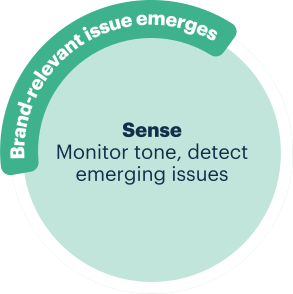
This is your early-warning system.
“Sensing” means detecting signals before they escalate into full-blown issues. That goes beyond traditional media monitoring.
You should be tracking:
- News coverage and social signals
- AI-generated answers about your brand
- Internal spikes in questions from sales, HR, or support
- Screenshots or narratives circulating outside official channels
Where teams go wrong:
They rely too heavily on traditional media monitoring. By the time coverage appears, the narrative is already forming elsewhere.
What to do instead:
Expand your monitoring to include AI platforms and internal signals. If you’re only monitoring the headlines, you’re already late to the party.
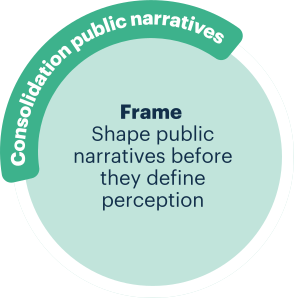
2. Frame
This is where most crises are won or lost.
“Framing” means publishing your version of events before speculation fills the gap.
You don’t need to craft a perfect statement, just a clear, factual anchor while you’re figuring out the details.
That could be:
- A short newsroom update
- A timestamped holding statement
- A basic FAQ clarifying what’s known and unknown
Where teams go wrong:
They wait for full certainty. Meanwhile, the story moves without them.
What to do instead:
Prepare pre-approved templates in advance. The middle of a crisis is not the time to align on wording.
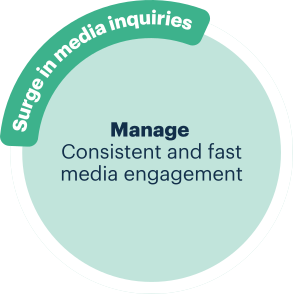
3. Manage
Now is the time to start thinking about internal alignment.
At this stage, you’re coordinating:
- Communications
- Legal
- Leadership
- HR and customer-facing teams
Everyone needs to be working from the same version of events.
Where teams go wrong:
Information lives in too many places. Teams operate on slightly different versions of the story.
What to do instead:
Use your newsroom as the single source of truth. Everything else should point back to it.
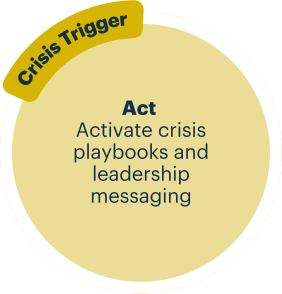
4. Act
This is the external response.
You’re now:
- Responding to journalists
- Correcting misinformation
- Updating stakeholders
- Publishing verified facts
Where teams go wrong:
They communicate too vaguely. Generic statements don’t travel.
What to do instead:
Address misinformation directly. Quote the incorrect claim and replace it with verified facts.
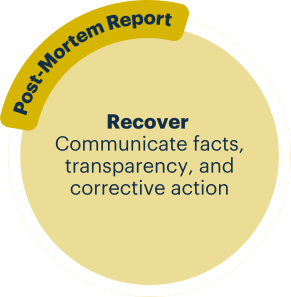
5. Recover
Once the immediate pressure drops, the real evaluation begins.
Look at:
- Media tone and coverage quality
- Stakeholder trust
- Search and AI-generated summaries
- Internal feedback
Where teams go wrong:
They move on too quickly without assessing what actually happened.
What to do instead:
Audit your owned content. Identify what gaps allowed confusion or misinformation to spread.
6. Improve
This is where resilience is built.
Every incident should strengthen your future response.
Update:
- Crisis playbooks
- Approval workflows
- Monitoring setups
- Executive training
Where teams go wrong:
They treat crises as one-offs instead of learning opportunities.
What to do instead:
Turn every incident into a repeatable improvement. Today’s edge case becomes tomorrow’s standard scenario.
Applying the Crisis Lifecycle Framework IRL
Frameworks only deserve the hype if they hold up in real situations.
Here’s how the Crisis Lifecycle Framework plays out across three common PR scenarios:

Scenario 1: Executive comments taken out of context
Your CEO gives a speech. Shortly after, you notice certain comments being taken out of context and discussed on social media. The conversation is still contained, but it’s starting to gain traction.
Sense:
You spot the early signals through social monitoring, tagged posts, and internal alerts. You assess which parts of the speech are being clipped or misinterpreted, who is amplifying it, and whether the conversation is gaining traction beyond a few isolated posts.
Frame:
Instead of waiting, you publish a short newsroom statement that clarifies the original context of the comments. Rather than reacting defensively, you provide the full picture: what was said, what was meant, and what might be missing from the circulating clips.
Manage:
You align internally on how to handle the situation if it escalates. Comms, legal, and leadership agree on positioning, while the CEO is prepped in case follow-up questions arise. Customer-facing teams are given clear guidance so responses stay consistent.
Act:
You engage selectively where it matters. You provide context to journalists who reach out, reference the full speech when needed, and reinforce the intended message without over-amplifying the issue.
Recover:
You monitor whether the conversation stabilizes. Are people referencing the full context? Is the narrative losing momentum, or still gaining traction? You step in again if needed, but avoid overcorrecting.
Improve:
You review how early the signals were picked up and how effectively the situation was contained. You refine monitoring, messaging prep, and executive training to reduce the risk of similar misinterpretations in the future.

Scenario 2: AI spreads incorrect information about your brand
An AI-generated answer falsely claims your company is involved in a controversy. Screenshots start circulating on X, and internal teams begin flagging it.
Sense:
You detect the issue through AI monitoring, social screenshots, and inbound questions from sales. You verify what the AI is actually saying, which platforms are showing it, and how widely it’s being shared.
Frame:
You publish a clear correction in your newsroom that addresses the false claim directly. You state what’s incorrect, provide the verified facts, and create a stable, citable source that others, including journalists and AI systems, can reference.
Manage:
You align internally on how to handle the misinformation. Sales and HR teams get clear guidance on how to respond to questions, while leadership is briefed on the issue and the official position.
Act:
You actively correct the misinformation in context, responding to posts where the screenshots are shared, referencing the incorrect claim, and linking back to your newsroom update as the source of truth.
Recover:
You monitor whether the correction is being picked up. Are journalists referencing your version? Are AI answers updating? Is the volume of misinformation decreasing or still spreading?
Improve:
You identify why the AI generated the incorrect claim in the first place - be it gaps in your owned content, outdated information, or lack of clear sources - and strengthen your content to reduce the risk of future inaccuracies.

Scenario 3: Product failure or operational issue
A couple of customers mention issues with your product. It’s not widespread yet, but the complaints are consistent enough to raise concern. You start to suspect this could escalate if left unchecked.
Sense:
You pick up the early signals through customer support tickets and a handful of social mentions. You look for patterns: Are the issues similar, coming from the same product batch, or tied to a specific region or use case?
Frame:
As the picture becomes clearer, you prepare to act before the issue spreads. You draft an initial update that acknowledges the potential issue and clarifies what you’re investigating, so you’re ready to publish quickly if needed.
Manage:
You align internally across comms, support, product, and operations. Teams agree on what is known so far, how to respond to incoming questions, and when to escalate externally. Leadership is briefed on potential impact.
Act:
You communicate selectively and early. Affected customers are informed directly, and if the issue starts gaining visibility, you publish a clear update outlining what’s happening and what customers can expect next.
Recover:
You monitor whether the issue stabilizes or spreads. Are complaints increasing? Are customers reassured by your response? You adjust communication as needed to prevent confusion or escalation.
Improve:
You review how quickly the issue was detected and how effectively it was contained. You refine monitoring, escalation thresholds, and communication workflows to catch and address similar issues earlier in the future.
FAQ: Crisis communication framework
What is a crisis communication framework?
A crisis communication framework is a structured approach that helps organizations respond to issues consistently and effectively. It defines the stages of response, from early detection to post-crisis improvement.
Why is a structured crisis communication strategy important?
Without structure, crisis response becomes reactive and inconsistent. A clear framework ensures teams move faster, align internally, and communicate more effectively under pressure.
When should a crisis communication plan be activated?
As early as possible. The “Sense” stage exists to catch signals before they escalate. Waiting until an issue is fully visible often means you’ve already lost control of the narrative.
How does the Crisis Lifecycle Framework improve response speed?
By giving teams predefined stages and actions, the framework removes uncertainty. Instead of debating what to do, teams can focus on execution.
What tools support a crisis communication framework?
Most teams use a mix of media monitoring, internal communication tools, and crisis communication software. The key is having a central place where verified information is published and updated.
The takeaway
Most teams already have the pieces in place. Monitoring, messaging, approvals, and escalation paths. What’s often missing is how those pieces connect when things start moving.
The Crisis Lifecycle Framework helps tie that together, so you’re not left figuring it out in the heat of the moment.
If you’re looking at how this plays out in practice, from monitoring to publishing to keeping everything in one place, it’s exactly what modern crisis communication setups are built around.
Presspage helps teams put that structure in place. Find out how we can help you level up your crisis communication strategy.